Introduction

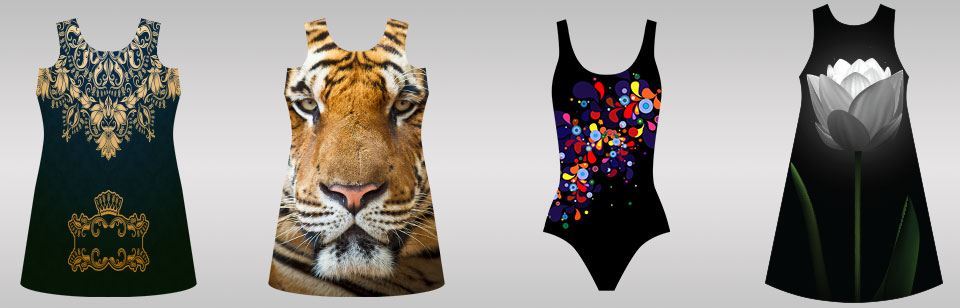
Transfer printing on pre-cut elements. Used technology (sublimation) provides very good quality and colour matching on polyester materials and similar fabrics. We use certified Oeko-Tex Standard 100 Class 1 inks, ensuring the printed fabrics are safe for use, even for small children.

Difference between printing on pre-cut elements and roll to roll printing

For many products the right positioning of the design on the element is very important. In elements, where a design is arranged in centre, at the edge or in mirrored designs even a few millimetres offset will be visible in final product. More problems arise from the complexity of some models, where a pattern needs to be matched across different elements or adjusted to sizes. The solution to this issues is printing on pre-cut elements - based on client's designs (or basing on patterns from our catalogue) we can precisely apply the prints to specified position on the element.

Printing on pre-cut elements – additional benefits

We also offer a service, that combines two techniques – first the elements are machine pleated, then printed. As a result only the visible part of pleats is printed leaving the rest of the fabric intact. We can print any design using this technique, not only single-colour fills or gradients, although these are the most popular. This service can be further extended by combining it with laser cutting (done by one of our cooperants) - this enables us to produce laser cut, printed elements with optional adhesive layer, that are can be used as smaller applications.

Knowledge Base: Printing

Sublimation printing is possible on polyester fabrics and materials with a high content of polyester or other synthetic fibers (such as polyamide, elastane).

Yes, printing can be carried out on both lightweight (e.g., chiffon) and heavyweight materials (e.g., barbie, sports knits).

Yes, the material should be resistant to high temperatures—sublimation involves heating to approximately 190–200°C. Fabrics not properly stabilized during production may shrink when exposed to these temperatures.

No, sublimation inks bond only to synthetic fibers. Printing is not possible on natural-fiber-only fabrics.

Printing is possible on blends (e.g., polycotton), but the print will only attach to the synthetic fibers—for example, if the content is 50% polyester, the print will be half as intense. The remaining cotton fibers will not take the print.

Files should be prepared in raster format (TIFF), sRGB color space, with a minimum resolution of 150 dpi and at the target size in centimeters.

Yes, but remember that with sublimation printing, only lighter areas of the material can be darkened or colored. White cannot be printed on black material; the result will be invisible due to the limitations of the technology.

Yes, we print on patterns — including blouses and skirts for sunray pleating. Please add approximately 5 cm bleed to each side in your design files.

No, despite technical possibilities, the quality cannot be guaranteed on the entire surface. Sublimation printing is sensitive to fabric thickness changes and cannot penetrate deep into fibers. As a result, errors—the most common being unfinished print under seams or hoods, blurred print, or areas missed by the ink—may occur.